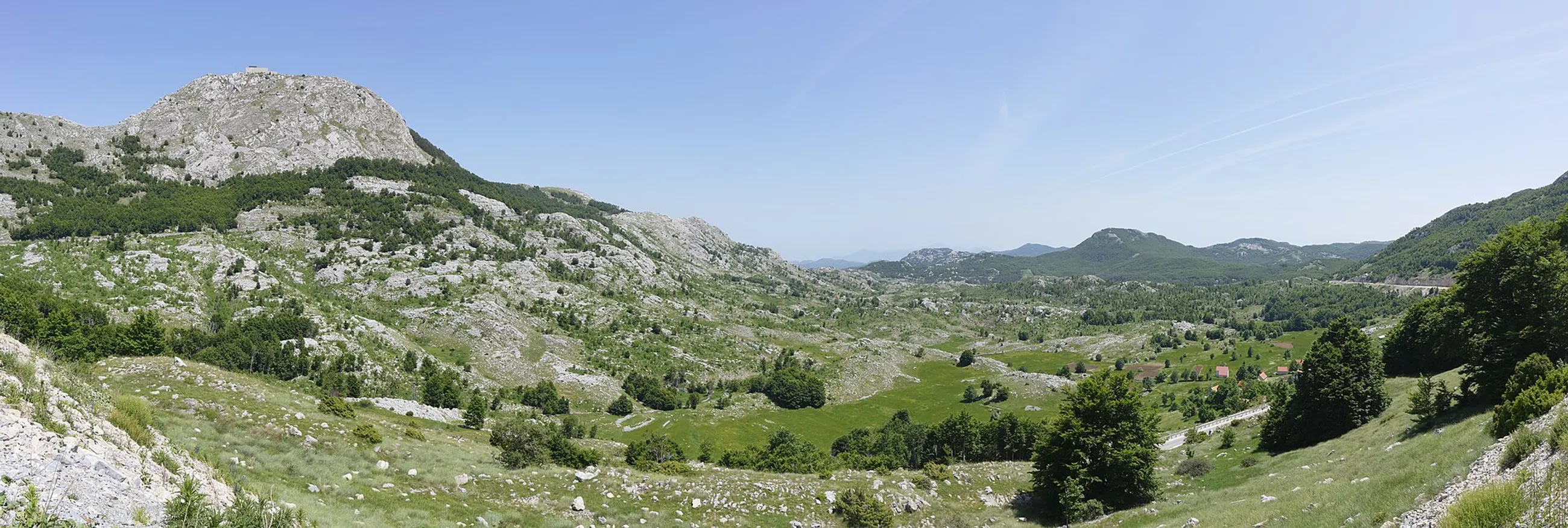
Lovćen is the black mountain that gave Montenegro its name, and the country treats it accordingly: the massif behind Budva and Kotor is a national park, and its second summit carries the tomb of the national icon. That tomb, the Mausoleum of Petar II Petrović-Njegoš, poet, prince-bishop and the closest thing Montenegro has to a founding legend, crowns Jezerski vrh at 1,657 m.
The visit has a pleasing sense of ritual. From the parking area you enter a tunnel bored into the summit and climb 461 steps to the mausoleum, where two granite giantesses guard Njegoš’s resting place beneath a gilded canopy. Then you step out onto the circular viewing terrace and get the reason everyone comes: on a clear day the panorama covers a startling share of the entire country, from the Bay of Kotor across the interior mountains toward Albania, with the Adriatic glittering along one edge.
The drive is half the experience. Most routes from Budva go via Cetinje and then wind up through the park; the alternative descent toward Kotor by the old serpentine road is spectacular and not for nervous drivers. There is a national-park fee on entry and a ticket for the mausoleum itself; check current prices at the gates.
Count on about 1.5 hours each way from Budva by car, and bring a layer: the summit is markedly cooler than the coast. No public bus reaches the top, so it is a drive, a taxi, or an organised tour, very often bundled with Cetinje below.